EN / ES abajo / DE unten ↓
Artwords — Writing Images.
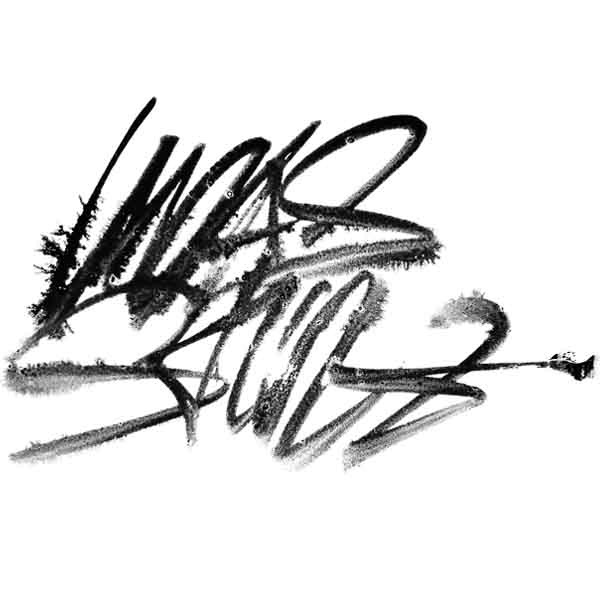
Lucas Stolz (*1985, Basel) explores the frontier between writing and painting and how signs, tools, and materials influence meaning. His work breaks with legibility, opening up space for alternative modes of visual communication. The artist lives and works in Barcelona.
He holds a Masters degree in Illustration from IDEP Barcelona and a BA in Graphic Design from HfG Schwäbisch Gmünd. Early on he built a career as a graphic designer, with a focus on calligraphy, hand letterings and typography, which led to increasingly experimental techniques that gave birth to his current artistic practice, where Stolz creates visual artefacts out of handwriting.
Lucas Stolz is represented by Max54 Gallery.
Artistic Practice
Lucas Stolz understands calligraphy as a painterly act. Signs and symbols as raw material for images in which words dissolve, leaving traces of a body that writes, where it could paint.
In his work, he explores four fundamental levels of handwriting: the invention and transformation of signs; continuous writing, which, through repetition, makes our humanity visible; the development of custom writing tools, that shape the stroke; and the analysis and repurposing of materials from diverse writing cultures.
Stolz develops processes and techniques that are idiosyncratic, almost defiant. They demand physical effort, they distort, chop, and multiply the stroke—giving it temperament. This process re-examines the question of authorship: Who is writing here—the hand, the tool, or the surface?
Throughout, meaning stays ambiguous. Signs are invented, or heavily distorted, they become anti-writing—where lines suggest a message while simultaneously denying it. Where legibility breaks down the viewer's own interpretations are liberated. A new world opens up, where writing leaves the flat surface and becomes multi-dimensional.
Exhibitions & Prizes
2026 | Unwriting Performance – Theatervierter Fest, Augsburg, Germany (12-14 June)
2026 | Unwriting – STROKE, solo booth, art fair, Munich (May 1st-3rd)
2025 | Artwords – Max54 Gallery, solo show, Augsburg, Germany (May 1st – July 31st)
2025 | Silent Words – ARTMUC, solo booth, art fair, Munich, Germany (October 10-12)
2024 | Zeiggeist Cycles – ARTMUC, solo booth, art fair, Munich (October 25-27)
2024 | Einfallspinsel – INCART, solo booth, art fair, Hamburg (September 6-8)
2024 | Max54 Gallery – group exhibition, Augsburg (May 1st to July 31st)
2024 | Homiens Art Prize Finalist – with the work "Wabi Sabi"
2024 | Villa meets Design – pop-up with Max54 Gallery and VonPoll, Augsburg (April)
2024 | Serigraffiti – STROKE, solo booth, art fair, Munich (September 9-12 May)
2024 | Zeiggeist – ARTMUC, solo booth, art fair, Munich (April 12–14)
2023 | Ö – STROKE, solo booth, art fair, Munich (April 12–14)
2022 | 33 Show – 22 Art Gallery, group exhibition, Munich (December 8 – January 7)
2022 | System Errorr – STROKE, solo booth, art fair, Munich (April 12–14)
2021 | Error 404 – The Other Art Fair, digital exhibition (November 8–29)
2012 | Media Map – IAM Gallery, Madrid, group exhibition (November 8–29)
2026 | Unwriting – STROKE, solo booth, art fair, Munich (May 1st-3rd)
2025 | Artwords – Max54 Gallery, solo show, Augsburg, Germany (May 1st – July 31st)
2025 | Silent Words – ARTMUC, solo booth, art fair, Munich, Germany (October 10-12)
2024 | Zeiggeist Cycles – ARTMUC, solo booth, art fair, Munich (October 25-27)
2024 | Einfallspinsel – INCART, solo booth, art fair, Hamburg (September 6-8)
2024 | Max54 Gallery – group exhibition, Augsburg (May 1st to July 31st)
2024 | Homiens Art Prize Finalist – with the work "Wabi Sabi"
2024 | Villa meets Design – pop-up with Max54 Gallery and VonPoll, Augsburg (April)
2024 | Serigraffiti – STROKE, solo booth, art fair, Munich (September 9-12 May)
2024 | Zeiggeist – ARTMUC, solo booth, art fair, Munich (April 12–14)
2023 | Ö – STROKE, solo booth, art fair, Munich (April 12–14)
2022 | 33 Show – 22 Art Gallery, group exhibition, Munich (December 8 – January 7)
2022 | System Errorr – STROKE, solo booth, art fair, Munich (April 12–14)
2021 | Error 404 – The Other Art Fair, digital exhibition (November 8–29)
2012 | Media Map – IAM Gallery, Madrid, group exhibition (November 8–29)
Education
2010 | MA in Illustration at at IDEP Barcelona
2009 | BA in Graphic Design at HfG Schwäbisch Gmünd
2009 | BA in Graphic Design at HfG Schwäbisch Gmünd
EN / ES / DE unten ↓
Artwords — Escribir imágenes
Lucas Stolz (nacido en 1985, Basilea) explora la frontera entre la escritura y la pintura: cómo los signos, las herramientas y los materiales transforman el lenguaje. Sus obras rompen con la legibilidad, dando lugar a un nuevo lenguaje visual. El artista vive en Barcelona.
Completó su Licenciatura en Diseño Gráfico en 2009 en HfG Schwäbisch Gmünd y un Máster en Ilustración en 2010 en IDEP Barcelona. Expone su obra en exposiciones y en ferias de arte internacionales. Lucas Stolz está representado por la Galería Max54.
Práctica Artística
Lucas Stolz entiende la caligrafía como un acto pictórico. La escritura como proceso de desarrollo de imagen, en el cual las palabras se disuelven, dejando símbolos como rastros de un cuerpo que escribe, aunque también podría pintar.
En su obra, explora cuatro aspectos fundamentales de la escritura a mano: la invención y transformación de letras; la escritura continua, que, mediante la repetición, hace visible lo humano; el desarrollo de sus propias herramientas de escritura, que afectan su trazo; y el análisis y la redefinición de materiales, inspirado por distintas culturas de escritura.
Stolz desarrolla así técnicas idiosincrásicas, casi desafiantes. Sus herramientas exigen esfuerzo físico, distorsionando, cortando y multiplicando el trazo, dándole carácter. Este proceso replantea la cuestión de la autoría: ¿Quién escribe aquí: la mano, la herramienta o la superficie?
El significado de los símbolos nunca permanece estable. Se inventan, se abstraen y se distorsionan, transformándose en anti-escritura – en líneas que sugieren significado y, al mismo tiempo, lo niegan. Donde la legibilidad se rompe, se libera la imaginación del espectador. Se abre un nuevo mundo pictórico, un lenguaje visual diferente – los signos saltan de la superficie y entran en el espacio.
EN / ES / DE
Artwords — Bilder schreiben
Lucas Stolz (geb. 1985, Basel) erforscht den Grenzbereich zwischen Schrift und Malerei – wie Zeichen, Schreibwerkzeuge und Material die Sprache verändern. Seine Arbeiten brechen mit der Lesbarkeit und lassen so eine neue visuelle codes entstehen. Der Künstler lebt in Barcelona.
Er hat 2009 einen BA in Grafik Design an der HfG Schwäbisch Gmünd und 2010 seinen Master in Illustration an der IDEP in Barcelona abgeschlossen. Lucas Stolz zeigt seine Arbeiten in Einzel- und Gruppenausstellungen sowie regelmässig bei internationalen Kunstmessen. Lucas Stolz wird von der Max54 Galerie vertreten.
Künstlerisches Werk
Lucas Stolz versteht Kalligrafie als malerische Handlung. Schreiben als Entwicklungsprozess für Bilder, in denen sich Worte auflösen, Zeichen als Spuren eines Körpers, der schreibt, obwohl er auch malen könnte.
In seinen Arbeiten untersucht er vier Grundebenen der Handschrift: die Erfindung und Veränderung von Zeichen; das kontinuierliche Schreiben, das durch Wiederholung das Menschliche sichtbar macht; die Entwicklung eigener Schreibwerkzeuge, die den Strich prägen; sowie die Analyse und Neuverwendung von Materialien aus unterschiedlichen Schreibkulturen.
Stolz entwickelt so Techniken, die eigensinnig sind, fast widerspenstig. Sie fordern den Körper, sie verzerren, rhythmisieren und vervielfachen – das gibt dem Strich Temperament. Der Prozess stellt die Frage nach Autorschaft neu: Wer schreibt hier – die Hand, das Werkzeug oder die Oberfläche?
Die Bedeutungsebene bleibt dabei nie stabil. Zeichen werden erfunden, abstrahiert, verfremdet, so dass sie sich in Antischrift verwandeln – in Linien, die Bedeutung andeuten und zugleich verweigern. Wo Lesbarkeit bricht, beginnt das schauen. Es öffnet sich eine neue Bildwelt, eine visuelle Sprache –die Zeichen treten aus der Fläche in den Raum.